

There is no doubt that search is moving faster than ever. If the days go on like this, the only search method that people rely on for finding different information, goods, and services from the internet will not be the search results. These days, people are posing questions to their AI assistants, voice assistants, and answer engines directly.
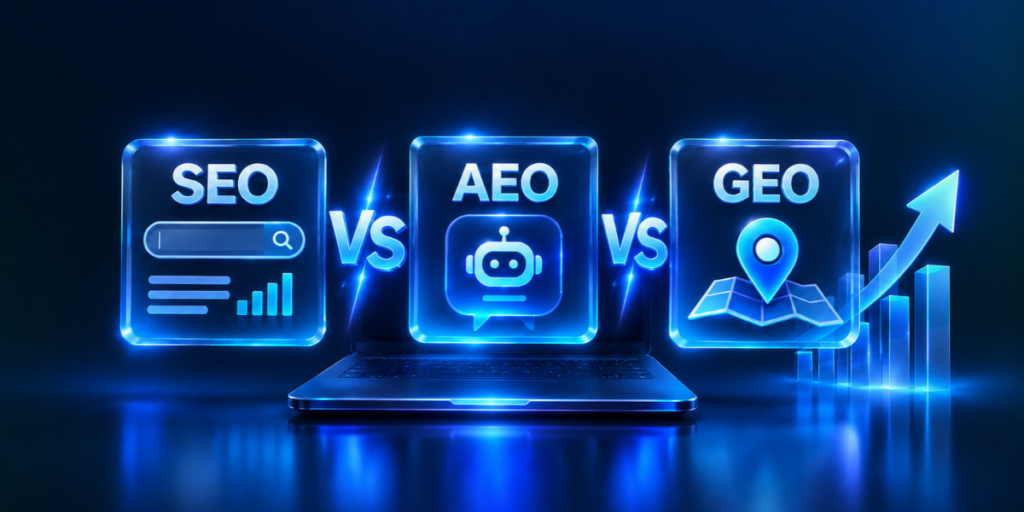
Due to this change, Search Engine Optimization (SEO), Answer Engine Optimization (AEO), and Geo-Search Engine Optimization (GEO) have become essential parts of online businesses. SEO, AEO, and GEO are all marketing channels aimed at boosting website visibility, but each of them works differently.
If a company is able to understand these three marketing methods and their differences, it might be easier for the business to select the one that suits it most and avoid unnecessary expenses. This article is a detailed comparison of SEO, AEO, and GEO that we have put together for your convenience, and in it we explain how each method works so you will know exactly what kind of results you expect in return in the future year 2027.
What Is SEO?
Search Engine Optimization (SEO) refers to the actions associated with developing a website to ensure that it ranks high on standard search engines.
The goal is for search engines to recognize a website and find out if its content fits an inquiry. Some vital components of good SEO are:
- Keyword analysis and updating a website’s content
- Technical SEO and site efficiency
- Internal link structure
- Backlink creation
- Local SEO
- On-page and off-page optimization
- Improvement of user experience
SEO requires time, because search engines need to go through the content before its ranking occurs. Nevertheless, good SEO provides a chance for businesses to attract organic traffic permanently.
What Is AEO?
AEO represents the term Answer Engine Optimization, which is concerned with the optimization of content to enable search engines and answer engines to provide users with answers directly.
While the traditional approach focuses solely on ranking a webpage, AEO is focused on ensuring the content is fit for featured snippets, voice searches, AI responses, and other answer delivery experiences.
AEO is particularly useful with question queries such as;
- What is digital marketing?
- How does technical SEO work?
- What are the local SEO benefits?
- How do I increase traffic to my site?
Use of clear headings, simple answers, organized content, FAQs, and a conversational tone is important in achieving an effective AEO plan.
What Is GEO?
GEO refers to Generative Engine Optimization, which aims to enhance brand exposure in generative AI and AI-based search results.
People turn to AI for recommendations, comparison, understanding, and business options. GEO’s goal is to guarantee that people consider a particular business or their offerings.
GEO activities include:
- Creating strong and valuable content
- Securing significant brand mentions from appropriate sources
- Providing informative details about services/products
- Demonstrating knowledge and credibility
- Setting content in a way that will be understandable for AI systems
- Ensuring the company’s information is everywhere on the Internet
GEO is becoming substantially more important as the way of searching changes from traditional keyword searching to conversations with AI systems.
SEO vs AEO vs GEO: Key Differences
The biggest point of distinction between these approaches is their objectives in enhancing visibility.
While SEO is oriented towards traditional rankings, AEO is concerned with providing answers and answer-based search solutions. GEO is focused on increasing visibility within generative AI content.
- SEO asks, “What can we do to rank better?”
- AEO asks, “How can we become the answer?”
- GEO asks, “What do we need to do to be part of generative AI’s answers?”
While these methods are not the same, they complement each other significantly.
How SEO, AEO, and GEO Work
SEO is the beginning. If a website is technically sound, has useful content, the right keywords in the right spots, internal links, and is linked to by authoritative sites, the chance for an organic ranking is there.
But AEO aims to improve the understanding and accessibility of the information you get. You should provide content with a direct answer at hand, well-ordered subheadings, and brief clarifying statements to explain.
In turn, GEO focuses on the presentation of your business’s details over the entire digital landscape. Brand authority, third-party mentions, expert content reviews, as well as consistent messaging can boost a business’s AI ranking.
Taken together, businesses must realize that these three approaches are not independent and that a good content strategy is the only way to succeed through all three methods.
SEO vs AEO vs GEO: Which Delivers Faster Results?
No winner can be declared in a universal sense since the results depend on various parameters including the site in question, industry, competition, content quality, authoritativeness, and current online presence.
AEO can sometimes yield quick results if the site already has proper content, and it helps address specific queries. Optimized content can help appear in answer-centric search features without requiring years of authority building.
There are also quick opportunities that could be created by GEO, especially for brands that are already surrounded by a solid volume of mentions and reviews.
SEO requires greater patience. It may take a long time to rank well for competitive keywords, whereas less competitive keywords may show results much sooner.
It makes sense to adopt SEO as a long-term strategy and implement AEO and GEO for new search opportunities.
Which Strategy Is Best for Different Types of Businesses?
Various companies have varying priorities.
Local businesses: using local SEO together with AEO can help the shops pop up when searchers look up local queries and customer questions.
Web shops: SEO is great for letting people discover products, and AEO is good at solving customer inquiries, while GEO gives the brand more visibility on AI recommendations.
B2B firms: SEO and GEO can be particularly helpful as potential customers often search online for different firms, options, and the best ones before finally choosing a company.
Service providers: AEO can be a means of solving customer questions; meanwhile, SEO and GEO would build credibility for the business soon.
Newbie companies: A holistic strategy will allow startups to establish visibility in the search while building up the brand’s equity across both conventional and AI platforms.
Can SEO, AEO, and GEO Work Together?
Yes. To top it all off, combining them is typically the most efficient way to be on top in 2026,
Definitely the best way is for companies to use their SEO strategy to create a thorough blog article that would be one of the best results for a major search term. Inside the article, they can answer several questions clearly for AEO; the same piece can help you out in GEO, just by exhibiting expertise while at the same time providing consistent brand information.
Let’s say, for instance, that a marketing agency online decides to craft a comprehensive report on SEO services. This page could get the main topics right, answer the questions of a client repeatedly at a very practical level, be a great guide with clearly divided sections, not only talk of theory but also show skills in practice. That one resource would be useful for different kinds of searches.
SEO vs AEO vs GEO: Pros and Cons
SEO
Pros:
- Creates long-term organic presence.Establishes organic visibility over time.
- Generates sustainable traffic
- Supports brand authority
- Applies to various sectors
Cons:
- It takes time to become competitively ranked.
- Requires continuous optimization
- The performance may change based on algorithm changes.
AEO
Pros:
- Targets question-based searches
- Works well with voice or question queries
- Can enhance the visibility of given queries
- Promotes effective and informative material
Cons:
- Answers that are directly stated can lead to a decrease in website traffic.
- The features of search may change from time to time.
- Should include extremely relevant content
GEO
Pros:
- Improves search visibility with AI.
- Supports brand authority building efforts
- Adjusts to users’ behavior
- Increases your online reach and awareness at the same time.
Cons:
- Even though it is a developing field.Although it is a continuing field.
- Not all AI responses can be anticipated.
- Measuring the direct impacts can be difficult.
New horizons in SEO, AEO, and GEO: what’s next for the future of search?
Search will steadily become more conversational, more personal, and more AI-based. The user can seamlessly navigate from a traditional search engine to an answer engine, a voice assistant, and finally, to generative AI without realizing the transition.
That’s not to say that traditional SEO is going away. Search engines will remain dependent on trustworthy websites, relevant information, technical signals, and authority. But businesses will have to optimize their content for more than traditional rankings.
In the future, a digital strategy will be more and more about being discovered, understood, trusted, and useful in multiple search contexts.
Which Strategy Should You Choose?
In most cases, using one method only is not going to be most effective for a company. SEO should still be considered the foundation of marketing since it leads to organic visibility for years. AEO can be used when customers ask frequent questions seeking a prompt reply. GEO will come into the picture when a company is looking to be more visible on the new AI search and recommendation platforms.
Perhaps the quickest way to get results is by using focused AEO and GEO with SEO continuously instead of relying only on old-style rankings. What you’re most probably going to want to do with the various strategies is find out what their main strengths are and match those with the particular characteristics of the product audience, competitor landscape, brand strength, site authority, content quality, and business goals.
It seems to be the business’s job to decide which method is preferable and to decide whether each approach would provide value on the customer journey.
Conclusion
All three approaches of SEO, AEO, and GEO are interconnected modern-time approaches to search visibility. SEO is about building long-term rankings, AEO is about becoming the most useful answer, and GEO is about being more visible in AI-powered experiences. All three combined can help businesses create a more powerful and adaptable digital presence in 2026.
ClicX Technologies enables companies to develop effective plans around search content and digital presence. Reach out and get a free website audit with a certified specialist to find opportunities for more impactful organic and AI presence.
FAQs
Q1. Will SEO continue to be relevant in 2026?
Yes. SEO is crucial for creating and maintaining organic search visibility, traffic, and search authority over time.
Q2. What’s better, AEO or SEO?
No. AEO is an approach that complements SEO and enables content to be found in direct answers and conversational search.
Q3. How long does it take for SEO to be effective?
Competition, authority, technical health, content quality, and several months make up the majority of the websites.
Q4. Are there any advantages for small businesses to use GEO?
Yes. Small businesses can leverage GEO by developing expertise, credible mentions, valuable content, and consistent brand info.
Q5. Would it be advisable for businesses to adopt all three strategies?
Yes, if feasible, with resources. A blended approach can complement traditional search, AI-driven discovery, and answer engines.
Q6. Which is the quicker of the two ways to work?
AEO and GEO can generate quicker visibility opportunities, yet SEO can typically offer much more long-lasting organic development.