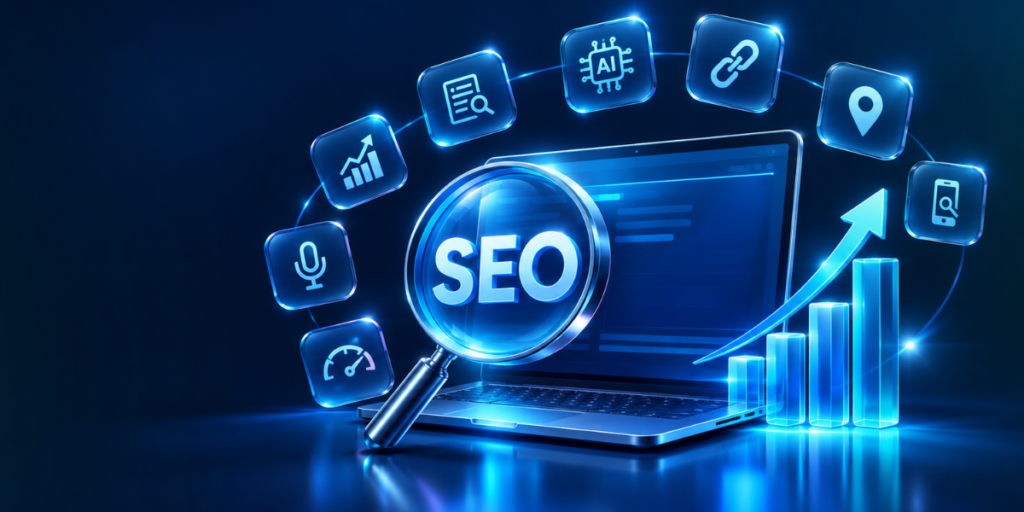

The SEO industry has shown rapid evolution, and business organizations need to be prepared for big changes in the way they become prominent online by the year of 2026. Search engines have become more intelligent; AI-processed search results are gaining ground; and consumer behavior seems to be shifting towards conversational forms of interaction. Traditional ranking approaches do not work alone anymore, which makes it necessary to adopt an integrated strategy involving the use of remarkable technical capabilities, solid content, brand positioning, and great user experience.
Knowing the SEO trends to come helps businesses be prepared for the future and have proper organic visibility. The following eight high-level SEO trends should be adhered to by enterprises in 2026:
1. AI Search Is Mainstream
Artificial intelligence is no longer a rising technological concept in search engines. At present, it is the backbone for how search engines provide their users with the needed information. People get more summaries made by AI, immediate answers, and customized search results than just links.
Because of these changes, it is time for companies to change their approach to content generation from something that is just about getting more links. Instead, they need to make sure it’s written in human language with enough detail to show they are the experts, but that AI systems can also process.
Business companies should not only pay attention to their rankings, but also how they can make use of AI answers generated for them. Thorough tutorials, in-depth expert knowledge sharing, a frequently asked questions section, and well-structured articles are more helpful and will remain even more important than they are now.
2. More AI in Google
Google keeps adding AI capabilities to almost every aspect of its search offerings. AI Overviews and smarter interpretation of queries, for instance, show the increasing use of machine learning to determine what content users see.
That said, such practices as keyword stuffing and other outdated SEO techniques will lose their effect entirely. Search engines have become capable of understanding context, user intent, and content quality much better.
If brands want to stand out in Google search, they should prioritize producing content that is truly helpful to the audience and addresses actual challenges. Long informative articles, expert reviews, market news, and user-focused guides will outperform content that is written just for SEO purposes.
Companies that develop and implement user intent-based content strategies have a better chance of being noticed by Google in its new search ecosystem.
3. Success Metrics Need to Adapt
Throughout many years, the success of SEO was mainly assessed by rankings and traffic from organic sources. Of course, these two aspects are really important too, but they are insufficient to show the whole situation.
In 2026, organizations will be more than just satisfied with looking at traffic numbers and rankings on pages. Metrics like brand Visibility, engagement rates, conversion quality, assisted conversions, and being cited in AI-generated results will come on the same level.
Even though fewer users should click on webpages where they find an answer on the results page immediately without further browsing, such sites might well be instrumental for building brand awareness and establishing authority.
Instead of being preoccupied merely looking at rankings of keywords, marketing departments should put their energies into measuring real business impact. The ways by which SEO can assist with lead generation, customer acquisition, and revenue growth should be a major concern for companies to ensure that they succeed soon.
4. Technical SEO Matters More
As search engines get better and more powerful, Technical SEO gets increasingly important in influencing website performance.
A technical SEO optimized site will assist search engines in their quest to crawl, access, and index the website’s content. Factors like slow loading rates of pages, missing links, unoptimized mobile experience, and failure to index a site can greatly undermine visibility, even if the content is remarkable.
The key technical elements that need attention are:
- Core Web Vitals
- Mobile optimization
- Structured data enhancement
- Accessing content available for crawlers
- Security
- Basic structure of a website
A sound technical base guarantees access to the content for users and the search engines.
Those companies that start investing in Technical SEO today will gain more advantages in the future because they will adapt to future changes in search algorithms along with following the trends.
5. AI-Enabled Websites Will Become Standard
AI is not just changing the search engines; it is also changing the websites themselves. More companies are introducing AI functionalities that enhance user experience and engagement.
Some examples are:
- AI chat assistants
- Personalized recommendations
- Dynamic content experiences
- Automatic customer support
- Intelligent search
These features facilitate visitors’ searches and ensure satisfaction.
Search engines tend to favor those websites that offer an excellent user experience. AI-powered websites have considerably greater chances of engaging users, reducing bounce rates, and keeping them on the site longer, which positively impacts SEO performance.
Companies employing AI technologies wisely will be more able to meet the users’ needs.
6. Authority Signals Are Not Just Backlinks
Backlinks continue to matter, but authority can now be established through numerous indicators.
Search engines assess whether the firm is able to manifest expertise, experience, authority, as well as trustworthiness on different channels. Mentions, reviews, expert contributions, social interactions, and brand recognition all serve as evidence of the firm’s credibility.
Companies can boost their authority signals by:
- Creating expert-led content
- Receiving mentions in high-profile industry publications
- Acquiring customer reviews
- Displaying some relevant contact information
- Establishing a positive image
A complete authority-building plan is not only limited to link building but has the aim of establishing true trust in the world of business.
Those brands that have demonstrated the highest level of expertise are likely to enjoy long-term SEO success.
7. Brand Clarity Will Be Your Differentiator
With AI-generated content proliferating, distinguishing content will become ever more difficult. Numerous businesses are going to produce similar types of content. That’s why brand identity will be a significant differentiator among them.
Developing a distinct brand personality, offering an exclusive point-of-view, and delivering a consistent message will definitely assist companies in getting the attention and trust they deserve.
When users come across a helpful article or post authored by a brand repeatedly, they tend to recall it and interact with the brand in some way. Not only that, but search engines also understand that certain branding elements are often indicators of expertise and reliability.
It is vital that businesses make sure that each and every piece of content they generate demonstrates their one-of-a-kind knowledge and value proposition rather than just regurgitating common information.
Putting brand strength together with search engine optimization delivers a formidable business edge if one operates in a highly competitive online environment.
8. The Rise of Conversational Content and Voice Search
The effect of voice assistants on users’ search methods is becoming more pronounced. The trend that users are no longer searching via keywords but instead starting to use natural language questions is becoming more common. Instead of asking “best SEO agency,” users may prefer to ask “which SEO agency will help to boost my website traffic in 2026?”
To make the most of this trend, the content needs to:
- Be able to answer questions of the users.
- Use natural speech.
- Provide the headings of the content in a conversational form.
- Directly answer the tasks of the users.
It is good to create content that imitates the natural way of speaking of people.
The companies that adopt their content strategy to match the users’ conversational search behavior have a better chance of increasing their profits in the future.
How SEO, PPC, and Brand Visibility Work Together in 2026
SEO no longer operates in isolation. It has become an integrated component of digital marketing, and companies that excel in this field are those who have the most well-balanced digital marketing strategies where SEO is used with paid advertisements and brand exposure.
Through SEO, marketers have the long-term opportunity to grow traffic organically; PPC allows for the immediate delivery of traffic and the opportunity to experiment with different things, and brand-building efforts increase trust and recognition of a company or product.
Becoming familiar with all of the different channels at once will help businesses interact with customers at each phase of the customer journey. Those customers who find your brand through organic search results may be more likely to try out a paid advertisement for the same product and vice versa.
Such a strategy, which integrates different types of communication, also enables companies to get the most out of a very limited visibility across lots of digital channels, including search engines, AI-powered platforms, and any discovery tools.
Preparing for the Future of Search
It may seem tempting in some way to focus exclusively on algorithms, but the future of SEO isn’t about that. We are talking more about users and their experiences, great content, and how it will serve a purpose, which is the main reason that determines whether or not SEO will be successful.
For businesses that spend their time creating great content and optimizing websites and building up authority and getting ready for the use of AI, they will definitely be ahead of the curve in search. Even with all these technological advancements and changes, the mission is still to give users the exact answer or the best recommendation that they are looking for at the very moment they ask the question.
The companies that are the first to adapt will gain a huge benefit since the search engines are also in an evolutionary phase.
Conclusion
In 2026, SEO will be influenced most probably by artificial intelligence, changing user behavior, higher technical standards, and increasing significance given to brand trust. Those businesses that adopt these shifts from early on may find an avenue to growth that is sustainable for them for quite some time. The main way to be successful in the future is to anticipate changes, whether it means boosting technical SEO, building up authority signals, going for conversational search optimization, or getting better brand visibility. ClicX Technologies helps companies keep up with search trends and develop ready-for-future digital strategies. Please get in touch and receive a free website audit from a certified professional.
FAQs
Q1. Is SEO still important in 2026?
Yes, SEO still matters a lot for organic discovery, lead creation, and steady digital growth over time.
Q2. How does AI impact SEO?
AI changes what people see in search results, and it tends to boost content that feels genuinely useful, well-structured, and made for real humans, not just crawlers.
Q3. What is the biggest SEO trend for 2026?
AI-driven search experiences, plus conversational search, are basically taking the lead right now.
Q4. Does Technical SEO still matter?
Absolutely. Technical performance influences how well sites get crawled, how they get indexed, and how visitors actually experience the pages.
Q5. Should businesses invest in PPC along with SEO?
Yes. PPC can give instant exposure while SEO is more like a long-term engine that keeps working.
Q6. How can brands improve online authority?
They should share specialist insights, earn trusted mentions, and keep a solid reputation online consistently.