
People who look something up online want to get the best answer in the blink of an eye. This is where on-page SEO can help you in a big way. It basically refers to making changes in your web pages so that search engines can easily comprehend your content and rank it higher.
Every tiny aspect, such as titles and headings, images, and page load speed, plays a part. If you are willing to get more eyes on you, more clicks, and organic growth over time, first learn on-page SEO. We will explain it simply.
What Is On-Page SEO?
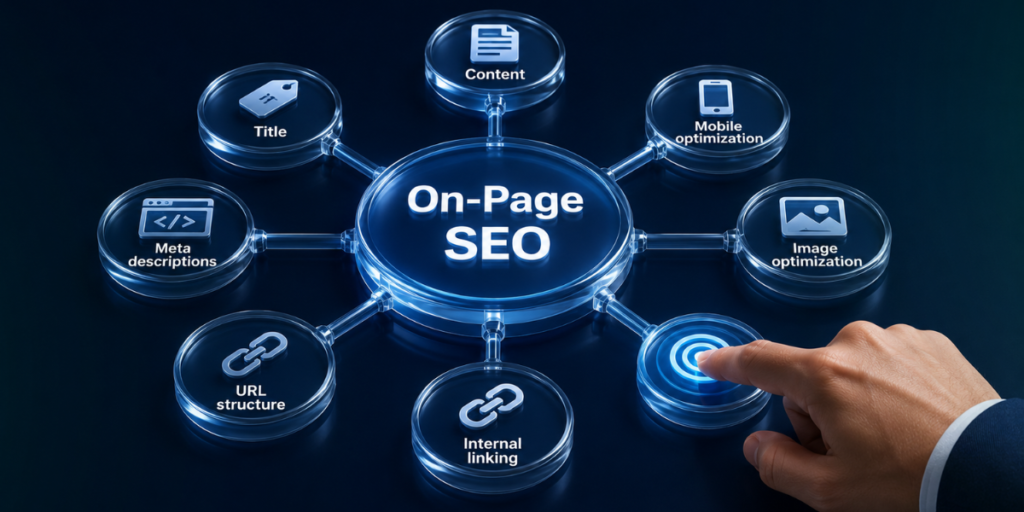
On-page SEO is the term for all the methods of optimization you implement right on your webpages to boost their rankings in search engines. Title tags, meta descriptions, heading text quality, internal linking, images, and URL structure are examples of such elements. Then again, off-page SEO is the method that looks at how external factors impact your site’s ranking, while on-page SEO is something that you can do as the site owner.
Simply put, on-page SEO is the practice of designing your website so that it can be easily interpreted by both search engines and human users. In fact, it is also frequently compared to website design. Yet, it is necessary for good SEO services , and when effectively implemented, it enables search engines to crawl, index, and rank your content in a more thorough and efficient manner.
Why Is On-Page SEO Important?
On-page SEO is really important because it has a direct impact on your website’s visibility in search engines, and these are some reasons why that’s important to you:
- It allows search engines to understand what your page is about
- It provides a better experience for users, which keeps visitors on your site for a longer period of time
- It improves your click-through rate through more appealing titles and descriptions
- It allows for better ranking and creates more growth over time with organic traffic
- It builds trust and credibility with both users and search engines
If you don’t have the right on-page SEO, it can be difficult for even the highest quality content to rank in search engines. Search engines are looking for clear signals, and on-page optimization provides those signals very clearly.
On-Page SEO vs. Off-Page SEO
It’s quite common for many people to mix up on-page SEO with off-page SEO, as they are totally different.
On-page SEO refers to the aspects of a website that one can directly control and change. Content quality, usage of internal links, the arrangement of headings, and technical aspects like schema markup are all examples of on-page SEO.
Off-page SEO, conversely, targets external factors that can affect a website’s search engine rankings. It covers elements like backlinks, social media shares, guest posts, and even friendly brand exposure.
If you mentally map it out, on-page SEO establishes your base, while off-page SEO governs the credibility and trust bestowed upon you from the ‘outside’. They complement each other, but on-page SEO is typically the first step as it equips search engines with a clear depiction of your site.
How to Do On-Page SEO for Your Site: 10-Item Checklist
Here is a quick checklist to improve the performance of your website:
- Optimize Title Tags
Use brief, relevant, and concise titles (60 characters or less). Natural use of your main keyword.
- Write Compelling Meta Descriptions
A quality meta description will help boost click-through rate because it provides something for people to click on.
- Use Proper Heading Structure
Use H1, H2, and H3 tags to create a logical hierarchy of content that is easily followed by the user and search engine.
- Focus on Quality Content
Create content to answer user intent. Don’t overstuff keywords.
- Optimize URLs
Make URLs short, descriptive, and readable.
- Add Internal Links
Connect to other relevant pages on your website for better navigation and the distribution of authority.
- Optimize Images
Label images with file names and alternative text that explain the image content.
- Implement Schema Markup
Rich results boost visibility in search results by displaying details such as author, publisher, and other information about the content in the search listing.
- Optimize Page Speed
Website speed is important to users and rankings. Optimize page speed by compressing images, using caching, and minimizing code.
- Mobile Friendliness
The majority of your website will be visited by mobile users, so it needs to be responsive and user-friendly.
By regularly reviewing and implementing this checklist, you can optimize your site’s performance over time.
Measure Your On-Page SEO Success
After making these changes, it is important to keep track of your performance. Here are some metrics you should watch:
- Organic Traffic: The number of visitors (from search engine results) who come to your site.
- Click Through Rate (CTR): How often users click on your site as a result of seeing it in the search engine results page (SERP).
- Bounce Rate: A high bounce rate may indicate problems with your content or the speed of your site.
- Average Time On Page: This metric reflects how engaging your content is.
- Keyword Rankings: This is the typical performance of each of your target keywords.
You can use tools such as Google Search Console and Google Analytics to track these metrics and identify areas for improvement.
Final Thoughts
On-page SEO can not be considered a one-time endeavor. It actually depends on regular updates, monitoring, and improvements to stay compatible with evolving search engine algorithms and user standards. Whether you do it yourself or employ professional SEO services, the objective is to develop a website that is informative, fast, and user-friendly.
Still, at ClicX Technologies, we realize that every website is unique and so are its SEO requirements. A properly optimized website leads to better rankings, not only that, but it also helps in gaining the confidence of your audience.
Get in touch with us and get a free website audit done by a certified expert. We will assist you in finding weaknesses in your on-page SEO as well as develop a plan to accomplish genuine, quantifiable results.
Frequently Asked Questions
Q1. What is the difference between on-page and off-page SEO?
On-page SEO happens inside of your website, like content, structure, internal linking, all that stuff. Off-page SEO is more like outside signals, backlinks, external mentions, and sometimes even brand signals.
Q2. How long does on-page SEO take before results appear?
Usually, around four to eight weeks, depending on the competition, the current health of your site, and how clean the setup is.
Q3. Does page speed really affect rankings?
Yes, and not just in theory. If your site is slow, people bounce quicker, engagement drops, and rankings usually follow that pattern.
Q4. Is schema markup necessary for every website?
Not strictly necessary for every website, but it is strongly recommended for richer results and better visibility in search.
Q5. Can I do on-page SEO by myself?
Sure, you can. Many people do the basics. Still, professional SEO services help with precision and faster, more stable outcomes.
Q6. How often should on-page SEO be updated?
Keep it up consistently, especially after algorithm updates or when you make major changes to pages, templates, or site structure.