
GEO vs SEO: Which Should Your Business Prioritize in 2026?
Search behavior is evolving at a pace that most companies really can’t keep up with. People simply don’t type queries into Google and scroll through ten blue links anymore. Instead, they are engaging in a direct conversation with AI tools and obtaining immediate answers. This change has led to a new debate about GEO vs SEO, and quite a few business owners are puzzled about which one is more important.
The fact is, each one has a part to play, just in a different manner. In this post, we’ll uncover the actual distinction between GEO and SEO, the reason your business will require both in 2026, and how to determine if your brand visible in the right places.
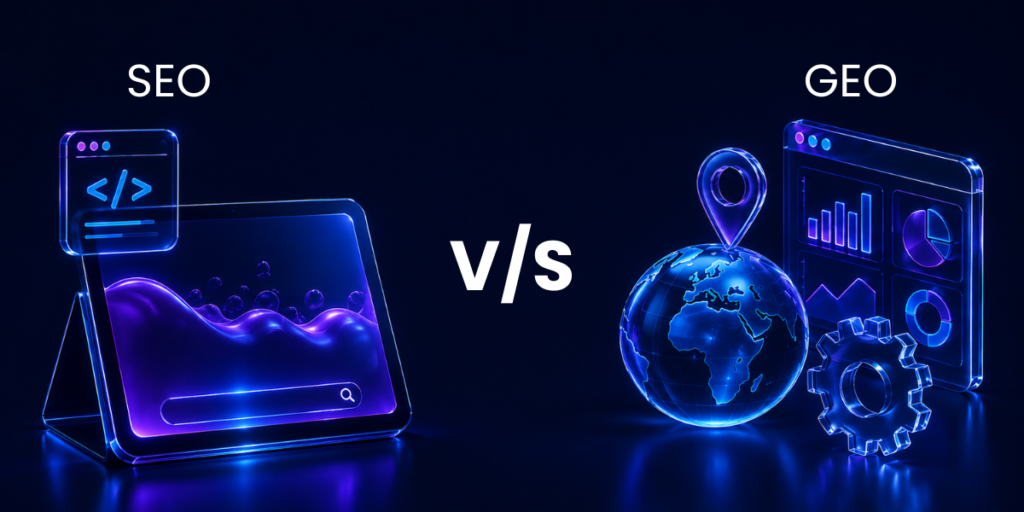
GEO vs SEO: What’s The Real Difference?
SEO stands for Search Engine Optimization, a technique that has been used for making websites appear on top of the search engine results for a long time. One mainly does SEO by choosing the right words or key phrases, getting other sites to link to one’s own site, speeding up one’s site, and working on the quality of content. The aim is quite straightforward: to have one’s site be among the ones shown when a person searches for something that one’s business is related to.
On the contrary, GEO, aka Generative Engine Optimization, is not only a brand-new concept but also operates in a totally different way. Whereas SEO is only concerned with improving search engine rankings, GEO is also concerned with making sure your brand gets mentioned and recommended by AI tools like ChatGPT, Google’s AI Overviews, AI Mode, and other generative platforms. For example, GEO affects whether your brand is the one cited by the AI assistant if a user asks the question, “Which is the best digital marketing agency near me?”
SEO and GEO are different matters that can be neatly summed up by saying SEO is looking for a place in the list of results, while GEO is the very answer in the first place. They don’t compete with each other. They are simply two different ways of achieving the same objective.
Why Businesses Need Both GEO And SEO In 2026
Some business owners even believe choosing is the only option. Well, that’s not how it’s done today. Both search engines and AI platforms are collecting data from the same sources, i.e., websites with quality content, well-organized, and having trustworthy signals.
Effective SEO lays a strong foundation. It ensures your website is fast, responsive, well-organized, and rich in informative content. GEO then takes it a step further by helping AI models understand, summarize, and quote your content easily. Though if your SEO is weak, it usually means there is nothing for AI tools to extract.
Companies that make a dual commitment to these strategies simply expand their coverage. Traditional searchers still discover them via SEO, and those who consult AI assistants are directed to them thanks to GEO. To not consider either one simply means losing access to an ever-increasing number of potential customers.
Signs Your Brand Has Poor AI Visibility
A company can have poor AI visibility and sometimes be completely unaware of it. Examples of indicating poor AI visibility within a brand are not showing up when you search with an AI tool about your industry, your competitors being mentioned while your brand isn’t, incorrect or inconsistent business details across directories and websites, thin or outdated content that does not provide answers to customers, and very little or no reviews/citations/mentions from third parties.
If you answered “yes” to most of these questions, your brand probably has very weak AI visibility despite how good your website may look from the outside.
How Businesses Can Measure AI Search Visibility
Measurement of AI visibility is not the same as checking your Google ranking, but it is pretty straightforward. The first step is to manually query various AI tools with the questions that a potential customer might be asking, for example, “best [your industry] in [your city].” Observe if your brand comes up and how it is portrayed.
Secondly, verify the consistency of your business information presence across local business directories, consumer review platforms, and even your own website. Also, examine your content to determine if it sufficiently, clearly, and directly addresses the questions, because AI tools tend to favor information that is extractable and properly formatted. Checking your backlinks and online mentions is equally important because, to determine the reputation and trustworthiness of a website, AI models tend to rely on how frequently and positively a brand is being mentioned elsewhere.
GEO Strategy Checklist For Businesses
If you want to get better at making your AI known, here is a straightforward list you can stick to. First, you must keep the information about your business the same wherever it is displayed on the internet.
Next, make content that will give a direct response to the usual customer inquiries in a simple way.
Third, aim at the creation of very authentic and original content that experts will recognize and use rather than pages simply stuffed with lots of keywords.
Fourth, support your online reputation management with a regular review system and credible mentions in the media.
Fifth, arrange the components of your page like headings properly so that it is very easy for both human readers and AI tools to find their way through the content.
Sixth, make your content follow the E-E-A-T principles of Google, which is the most trusted guide, and it will build your trust eventually.
Finally, keep up with the regular SEO activities as GEO will give better performance when it is based on solid SEO.
Final Thoughts
GEO and SEO are not two competing methods trying to capture your attention. Instead, they are two components of the same plan that are intended to help your business be found both by the people who search traditionally and by those who use an AI assistant to get recommendations. At ClicX Technologies, we have witnessed the results of businesses that combine both approaches, while others are losing their visibility very quietly without even getting aware of it.
If you do not have a clue about the present condition of your brand, then the right decision would be to proceed by having a clear and truthful insight into the effectiveness of your website. Why don’t we discuss this matter, so you can get a free website audit with a certified expert, and establish the areas of your GEO and SEO that require your focus the most?
FAQs
1. What’s the main difference between GEO and SEO?
SEO basically helps your website rank on search engines, while GEO is more about getting your brand picked up by AI tools, like when they “recommend” rather than just list results.
2. Does my business really need GEO if SEO is already working?
Honestly, yes, because a lot of people now discover companies through AI search experiences, not only through the classic blue links.
3. How long does it take to see GEO results?
It depends, but usually most businesses start noticing better AI visibility within a few months of steady, consistent work.
4. Can a small business compete with bigger brands in AI search?
Yes, absolutely, especially if your content is solid, your details stay consistent everywhere, and your reputation management is on point.
5. What role do reviews play in AI visibility?
Reviews act like trust signals, and many AI systems tend to treat that credibility as a deciding factor before making a suggestion.
6. How do I know if my website needs an audit?
If you’re not sure why results are slow or uneven, an audit will point out exactly what needs attention, and it can help you fix things without guessing.