
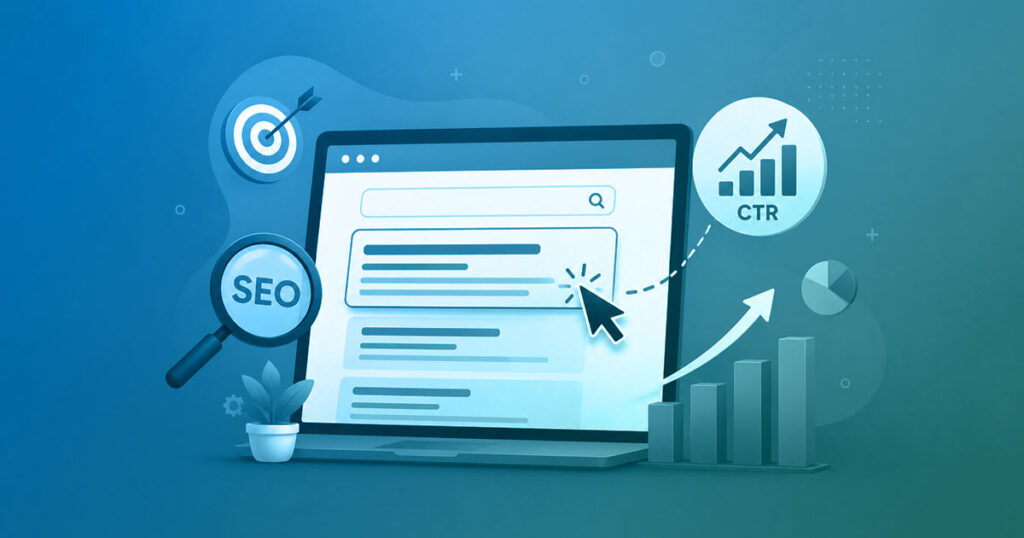

You will only win half of the war just by getting your site listed in Google’s search results. The real victory is getting visitors to click through to your site via your search result listing. This is where the Click-Through Rate (CTR) becomes very important. Many businesses put all of their energy into ranking instead of focusing on CTR.
CTR directly correlates with how much organic traffic you will get from Google. A higher CTR will indicate to Google that the content you are providing is relevant and valuable. This can increase your ranking as well. Throughout this article, we will provide you with everything you need to know about CTR in SEO and how to effectively improve your CTR.
What is the Click-Through Rate in SEO?
Click Through Rate (CTR) is the percentage of people who click on your site after finding it listed in SERPs, and this is a direct measure of the attractiveness or relevancy of your listing as it appears to searchers.
To illustrate, if your webpage has a total of 1,000 impressions and was clicked by 80 individuals, your CTR would be calculated as follows: 0.08/1,000 x 100% = 8%.
CTR is important beyond just being a “vanity” metric. The CTR can also determine whether the title tags, meta descriptions, and overall presentation of your listing are enough to get you to convert over your competition.
Why is Click-Through Rate Important for SEO?
The importance of CTR lies in its ability to show how your business reaches potential customers through actual website visitors.
Google uses CTR as a behavioral indicator because it serves as a ranking signal. If users consistently choose your result over others, it indicates relevance, which can push your rankings higher.
The only way to increase visitor numbers is through better CTR because existing traffic levels will not change without higher search engine rankings. A page in position 4 with a great title can outperform a page in position 2 with a weak one.
The return on investment from your content, PPC, and technical SEO investments increases when your CTR reaches higher levels.
More clicks create additional chances to turn website visitors into leads or customers, which helps your business expand.
How to Calculate CTR in SEO
The formula for calculating the Clickthrough Rate (CTR) is simple:
CTR = (Total Clicks ÷ Total Impressions) × 100
CTR can be measured in the Google Search Console and is used as an indicator for how well your website pages are performing, along with helping to identify any pages that need more optimization.
CTR can also be used in combination with a conversion calculator to track the number of actual conversions (leads and sales) generated from clicks.
What is a Good Click-Through Rate for Organic SEO?
The following are some benchmark ranges of CTR (click-through rate) typically seen for organic search results based on search engine positioning, business sector, and customer search intent:
‘Position One’ – 25-30% average CTR;
‘Position Two’ – 15-18%
‘Position Three’ – 10-12%
‘Position Four/Five’ – 6-9%
‘Position Six-Ten’ – 2-5%.
If your website ranks within the top three positions of SERPs (search engine result pages) but has an actual CTR that falls below these industry benchmarks, then your page’s title & description may require optimization. If you have an actual CTR above what the industry average is for a given ranking position, great job you are clearly doing something that works, now do it again!
Factors Affecting Click-Through Rate in SEO
Multiple factors determine whether a user will click your result or continue scrolling through other content:
- Title Tag: This element stands as the most critical element. A compelling, clear, and keyword-relevant title drives clicks.
- Meta Description: Although it does not directly impact rankings, a well-crafted meta description functions as promotional content for your webpage.
- URL Structure: User trust increases when they see clean, understandable URLs that show them what content will follow.
- Rich Snippets and Schema Markup: Your listing displays visual uniqueness through star ratings, FAQs, breadcrumbs, and other structured data.
- Search Intent Match: Users show greater clicking behavior when your title exactly matches their search requirements.
- Page Speed: User experience begins to feel better when websites operate at higher speeds, but slow websites create negative reputations which lead to users abandoning sites that demonstrate low performance throughout the day.
- Brand Recognition: Users click on brands they trust. The more times people see your brand across different platforms, the more your organic click-through rate will increase.
7 SEO-Optimized Strategies to Improve Click-Through Rate
1. Craft Compelling Title Tags
Your title is the first thing users see. Keep it simple, emotional, and relevant. Use numbers, power words, or questions.
2. Optimize Meta Descriptions
An intriguing meta description boosts curiosity. Make it natural, benefit-driven, and less than 160 characters.
3. Add Structured Data (Schema)
Schema markup allows your listing to show up with rich snippets such as FAQs, reviews, or prices, increasing visibility and click-through rates.
4. Improve Page Speed
Users don’t trust or engage with slow sites. Faster pages enhance user experience and indirectly CTR.
5. Match Search Intent
Ensure your content aligns with search intent. This results in less engagement.
6. Appeal to Emotion and Action
Terms such as “easy”, “fast”, “proven”, and “ultimate” boost interest and clicks.
7. Target Featured Snippets & SERP Features
Google now has AI Overviews and zero-click results. Snippet-friendly content ensures visibility in evolving SERPs.
The Future of CTR: How New SERP Layouts Impact Organic Results
The landscape of search is changing quickly. With AI Overviews, zero-click searches, and rich SERP features, Google’s introduction has made a difference in the performance of organic CTRs.
AI Overviews answer questions at the top of a SERP and mean that a user has no reason to click through to your site. Research indicates that this is leading to lower organic CTRs for users searching for information.
Zero-Click Searches occur when someone receives an answer from the SERP; examples would include featured snippets, knowledge panels, and local packs. The user has never visited a website with a zero-click search.
Your Strategy:
Instead of trying to fight against these changes, you should change your strategy to accommodate them. Focus your strategy on:
1) Targeting transactional and commercial keywords where users will still have to come to your website to convert.
2) Building authority on your brand so users know you and are searching for your listing specifically.
3) Optimizing for conversational and voice search.
4) Using schema to take the maximum amount of SERP real estate possible.
5) Create content that is deeper than what a user would get if they received a summary of the AI overview.
Companies that are going to succeed in the future will be those that fully understand the intent of the user and provide the user true value, not just at a summary level.
Final Thoughts
One of the least recognized ways to increase your organic traffic and ranking without changing your positions is by improving your CTR. This is because even if you slightly change your title tags or keep up with changing SERPs, any little change you make will have a cumulative effect in the long run.
We at ClicX Technologies assist companies in converting impressions into clicks and clicks into conversions by utilizing SEO strategies that are based on your data and are highly personalized to your objectives. Do you want to know how your CTR compares? Contact us and get a complimentary website review from a certified professional. Your next phase of organic growth will be triggered by just one discussion.
FAQs
1. What is CTR in SEO?
The percentage of users who click your website link after seeing it in search results constitutes CTR.
2. Why is CTR important for SEO?
The metric demonstrates website relevance, which leads to increased website traffic that helps websites achieve higher search engine rankings.
3. How can I increase CTR quickly?
You need to enhance titles and meta descriptions while implementing structured data to achieve rich results.
4. Does CTR affect Google rankings?
Higher CTR results show that content delivers more relevant information, which helps websites achieve better search engine rankings.
5. What tools can I use to track CTR?
The most common tool used for tracking CTR is Google Search Console.
6. Can page speed affect CTR?
Faster page load times create better user experiences, which lead to higher clickthrough rates because users trust the website more.