
Every company dedicates many hours and resources to digital marketing, but if the right data isn’t tracked, only guesswork remains to be able to determine if marketing efforts are effective or not. Determining marketing performance is a critical component of business, as it can pinpoint areas that are working, need some tweaking, or are great places for marketing investment. This is exactly where digital marketing KPIs and metrics become your best friends.
They give a solid idea of how well the campaign is performing and reveal the customer’s behavior. No matter if it is SEO, paid advertising, email campaigns, or social media, knowing the appropriate indicators gives you the power to make more informed decisions and get better business results by implementing a strategically planned digital marketing campaign.
What are KPIs in Marketing?
Many businesses ask a similar question: “What are marketing KPIs?”
In short, KPIs (key performance indicators) are measurable values that measure the success of your marketing campaigns and determine if your marketing strategies are accomplishing their goals.
KPIs are aligned with the business goals and provide you with a clear view of the success or failure of your marketing efforts.
Examples of marketing KPIs include:
• Organic website traffic
• New business leads generated
• Conversion rate
• Revenue generated from marketing campaigns
• Customer acquisition cost
Marketers can use KPIs to concentrate on metrics that genuinely contribute to the growth of the organization, as opposed to tracking every statistic available.
What is the Difference Between Marketing KPIs and Metrics?
These terms are often used interchangeably, but there is a difference.
- Marketing KPIs
KPIs are metrics that reflect how well your business is pursuing its core goals.
Examples include:
- Monthly qualified leads
- Organic traffic growth
- Return on ad spend (ROAS)
- Customer lifetime value
- Marketing Metrics
Metrics are individual datapoints that give further insights into campaign performance.
Examples include:
- Page views
- Bounce rate
- Likes and comments
- Email open rate
- Average session duration
In simple terms, all KPIs are metrics, but not all metrics are KPIs. KPIs are about business success, and metrics are about the “how” and “why” of business success.
Why Tracking Marketing KPIs Matters
Tracking the proper KPIs allows companies to make educated marketing choices based on facts rather than just opinions.
Some of the benefits include:
1. Better use of funds
2. Improved performance of campaigns
3. Faster and easier to make decisions
4. More return on investment
5. A clear understanding of customer behaviour
6. Continuous improvement of marketing
When a company regularly tracks performance, it is much easier to notice opportunities and improve poor-performing campaigns.
Essential SEO KPIs Every Business Should Monitor
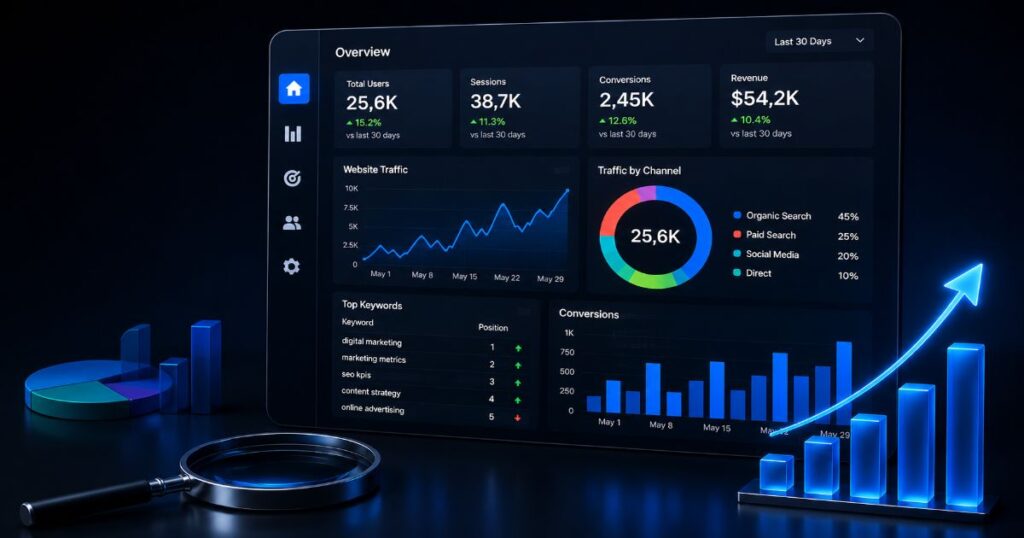
The results of search engine optimization are ongoing, as long as it is measured properly. These are some of the most useful SEO KPIs to measure your website’s visibility and growth.
- Organic Traffic
This indicates the number of visitors who come in from non-paid search engine results.
A boost in organic traffic typically means better visibility.
- Keyword Rankings
Monitor the performance of your important keywords over time.
Increased rankings can result in more qualified visitors.
- Organic Conversion Rate
However, traffic is not the only criterion.
Track the number of visitors who take a desired action, like filling out forms or buying products, or contacting your business.
- Backlink Growth
Quality backlinks increase your website’s authority and help you rank higher.
- Website Speed
Quick loading websites not only provide better user experience, but they also boost the search rankings as well.
Paid Advertising KPIs That Matter
When you are running paid campaigns, you have to monitor them carefully to get the best utilization of your ad dollars.
These are the top-most important KPIs for paid advertising.
- Click Through Rate (CTR)
Click-through rate is the number of users who click on your ad after viewing it.
The higher the CTR, the more relevant and engaging your ads are.
Formula:
CTR = (Clicks / Impressions) x 100
- Cost Per Click (CPC)
This indicates the cost of a click on your ad.
High-quality traffic and low cost per click (CPC) generally equals higher profits.
- Conversion Rate
This is the number of ads that lead to a desired action of customers.
The higher the conversion rate, the more effective the campaign.
- Return on Ad Spend (ROAS)
ROAS is a calculation that compares the revenue you’re making from an ad campaign with the amount you’re spending on it.
A higher ROAS equals more efficient advertising.
- Cost Per Acquisition (CPA)
CPA lets you know the cost to get one lead or customer.
Reduced acquisition costs lead to more profitable marketing overall.
Social Media KPIs to Measure Success
The days of the masses signing up for a social media account and following everyone are over. Businesses need to track engagement and conversions to assess the performance of the campaigns.
Here are some KPIs to keep in mind for social media:
- Engagement Rate
Measures likes, comments, shares, and interactions.
If you’re getting a lot of engagement, there’s probably some good content.
- Reach
Displays the number of different people who watched your video.
- Follower Growth
Growth that’s steady indicates growing brand awareness.
- Website Traffic
Monitor web traffic from social media sites.
- Lead Generation
Track the number of leads gained from social campaigns.
Multi-Channel Marketing KPIs
Businesses today use a variety of channels for their marketing efforts, such as SEO, paid ads, social media, email marketing, and content marketing.
Metrics that are tracked across multiple channels help determine the performance of the entire marketing strategy as opposed to individual campaign performance only.
A few of the most important cross-channel KPIs include:
- Total website traffic
- Marketing qualified lead
- Cost to obtain customers
- Customer lifetime value
- Overall conversion rate
- Revenue generated by different marketing channels
- Return on Investment
When all of these metrics are reviewed together, it will provide a complete picture of how effective your overall marketing efforts are.
Best Tools for Tracking Marketing KPIs
There are many different tools available that can help you to track and report on your KPIs.
Some commonly used examples of these types of tools include:
- Google Analytics
- Google Search Console
- Google Ads
- Meta Business Suite
- LinkedIn Analytics
- Looker Studio
- SEMrush
- Ahrefs
The use of multiple tools at once generally creates a more comprehensive overview of performance.
Common KPI Tracking Mistakes to Avoid
Many businesses collect large amounts of marketing data but struggle to gain meaningful insights.
Avoid these common mistakes:
- Tracking too many metrics
- Ignoring business objectives
- Focusing only on traffic
- Not measuring conversions
- Reviewing reports too infrequently
- Making decisions without sufficient data
A focused measurement strategy produces better marketing decisions.
Conclusion
Properly measuring marketing KPIs can uncover a lot of useful information, such as how effective the campaigns are, what kind of decisions you should make, and how you can get the most out of your investments. Instead of going after all the metrics that are available, concentrate on those that are really relevant to your business objectives. No matter whether you are working on SEO KPIs, Paid advertising KPIs, Social media KPIs, or Multi-channel marketing KPIs, regular tracking is the key to smarter marketing plans and more-effective results.
ClicX Technologies is a company that assists other companies through data-inspired marketing campaigns and leads to visible growth. You may be in touch with us and, as a bonus, get a website audit free of charge from a certified expert and find out what other online success opportunities can be brought to your attention.
Frequently Asked Questions
Q1. What are KPIs in digital marketing, like really?
KPIs basically measure how well marketing is doing against specific business goals.
Q2. How often should marketing KPIs be tracked?
I’d say review the key KPIs weekly, then check the more detailed reports each month. Not too often, not too rare.
Q3. What is a good click-through rate?
A good CTR depends on the platform and the industry, but better relevance tends to bring stronger results.
Q4. Which SEO KPIs are most important?
Organic traffic, keyword positions, conversions, backlinks, and website speed… all together they tell the bigger story, even if it feels a little repetitive.
Q5. Why are marketing KPIs important?
Because they help refine campaigns, show what is working, and support bigger marketing ROI.
Q6. Should small businesses track digital marketing KPIs?
Yes. Even if it’s small, tracking KPIs improves marketing choices and helps business growth stay on track.