
Digital advertising has changed significantly beyond the traditional approach of manually purchasing media and placing basic ads. The brands now require that each campaign should deliver results quickly, accurately, and in a way that can be measured. Programmatic advertising is a solution for that. It is a process that is done automatically and without the need for human intervention, i.e., it uses data, algorithms, and real time decision making to perform the sale and purchase of digital ad space. Advertisers can find the right audience at the right time across many platforms without the need to negotiate placements manually.
We will explain the concept of programmatic advertising, its operational mechanism, importance, and how companies can utilize it to achieve steady growth in the digital ecosystem, which is getting more and more competitive, in this complete guide.
What is Programmatic Advertising?
Programmatic advertising refers to the automated mechanism of purchasing and selling digital ad space through the use of technology and data centric systems. Instead of engaging in conventional bargaining, programmatic platforms deploy algorithms that position ads within fractions of a second. Essentially, the concept revolves around showing ads to users by interpreting data signals such as behavior, location, device type, and interests.
Automating the process minimizes the occurrence of mistakes, significantly reduces the time required, and enhances the overall efficiency. As a result, programmatic advertising is at the core of almost every modern paid advertising campaign that runs across various channels, including display, video, mobile, native, and connected TV. The strategy behind it is to concentrate less on the place where the ad is displayed and more on the person who views it.
How Programmatic Advertising Works?
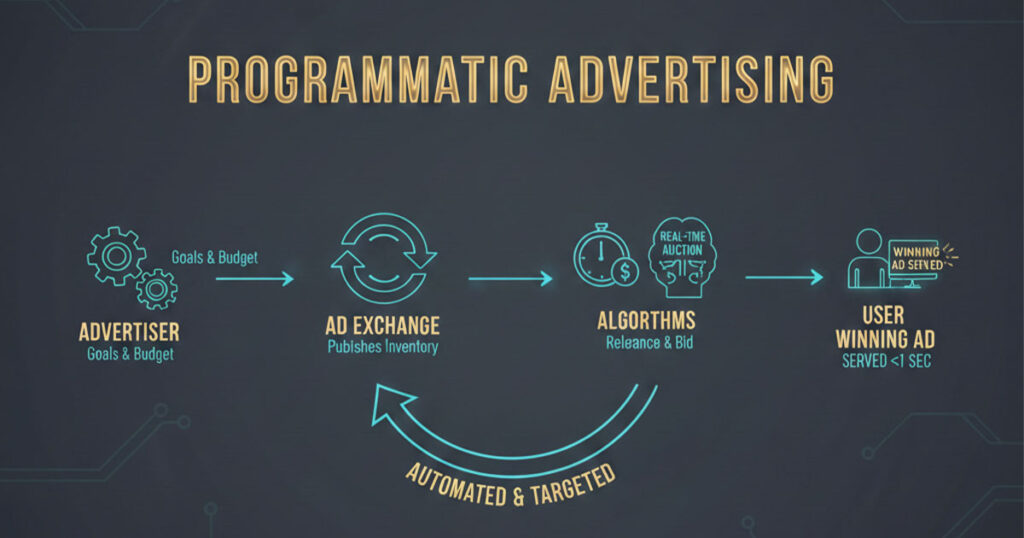
Programmatic advertising is a technology that operates through a well-organized ecosystem that links real-time advertisers, publishers, and data platforms.
- Advertisers set campaign goals, audience targeting, and budget.
- Ad exchanges provide publishers with access to their ad inventory.
- As soon as a user visits a site or app, an auction takes place at once.
- The algorithms determine the ad to be displayed according to its relevance and the bid value.
- In less than a second, the winning ad is served to the user.
All this is done automatically, and thus, ads are delivered to the appropriate audiences without any manual intervention.
Key Components of Programmatic Advertising
To gain a comprehensive grasp of programmatic advertising, one needs to be acquainted with the key components that constitute it.
- Demand-Side Platform (DSP)
The DSP makes it possible for advertisers to purchase ad spaces from several exchanges using a single interface. It also takes care of bidding, targeting, and optimization.
- Supply-Side Platform (SSP)
The SSP is a tool that enables online publishers to sell their ad inventories in one smooth motion by linking them up with several buyers at once.
- Ad Exchanges
They are the virtual markets where ads are purchased and sold via real-time bidding.
- Data Management Platform (DMP)
The DMP is a system that gathers and categorizes audience data for the purpose of improving ad targeting and campaign efficiency.
The above elements are the very foundation of programmatic advertising when they are viewed as working in tandem.
Types of Programmatic Advertising
Programmatic advertising is not one format. It has a variety of purchasing techniques depending on control, pricing, and access to inventory.
- Real-Time Bidding (RTB)
RTB is the most common form. Advertisements are purchased and sold through real-time open auctions.
- Private Marketplace (PMP)
PMPs bring about invitation-based auctions with premium publishers and more control.
- Preferred Deals
Advertisers negotiate with publishers at a set price but purchase impressions through the use of automated bidding.
- Programmatic Guaranteed
There is pre-reserved inventory, which is guaranteed to impress and is priced.
The models have varying transparency, control, and scalability.
Why Programmatic Advertising Matters Today
Online space is saturated, and there is not much attention to be given. Programmatic advertisement assists brands in reducing noise through relevancy and timing.
Key benefits include:
- Faster campaign execution
- Better audience targeting
- Real-time optimization
- Reduced ad wastage
- Scalable performance
Programmatic advertising is not an option anymore for any contemporary marketing company. It is critical for the creation of quantifiable results in competitive markets.
Programmatic Advertising vs Traditional Media Buying
- Buying Approach
Conventional media purchasing is based on negotiating by hand, fixed placements, and long-term contracts.
Programmatic advertising involves real-time automated systems to purchase ad inventory and data-driven systems.
- Targeting Focus
Traditional buying refers to channel, publication, or ad slots.
Programmatic is audience-oriented, and it involves data to target users on the basis of behavior, interests, and intent.
- Flexibility
Conventional campaigns do not provide much flexibility when placements have been done.
Campaigns on programs can be optimized, halted, or modified in real-time.
- Efficiency
The old-fashioned media purchasing is time-wasting and consumes resources.
Programmatic advertising is also automated and can be implemented more quickly, and is highly scalable.
- Reporting & Insights
Conventional reporting is not timely and usually not thorough.
Programmatic offers real-time reporting with performance details.
- Performance Impact
Conventional purchasing emphasizes reach and visibility.
Programmatic values performance, optimization, and ROI.
- Modern Relevance
In the modern world, traditional media buying has a supportive role.
The modern performance marketing strategies have been based on programmatic advertising.
Role of Data in Programmatic Advertising
Programmatic advertising is driven by data. The lack of data would make automation lack purpose.
Types of data used include:
Partner data Second-party data.
Third-party information to get wider audience information.
When these sources of data are combined, the advertisers are able to build accurate audience segments and provide extremely targeted messaging on a mass scale.
Programmatic Advertising Channels
Programmatic advertising goes across various touchpoints of the digital realm.
- Display Advertising
Banner and visual advertisements on websites and applications.
- Video Advertising
In-stream, out-stream, and related TV ads.
- Mobile Advertising
Applications and mobile web placements.
- Native Advertising
Advertisements that are not obtrusive.
- Audio Advertising
Advertisements are placed on music and podcasts.
This is a multi-channel reach that guarantees a consistent brand presence on the customer journey.
Programmatic Advertising and Paid Media Strategy
Programmatic advertising is a vital part of a paid media strategy. It works with search, social, and native channels to not only broaden the reach but also to make the campaign more efficient. Programmatic does not depend only on keywords or placements but also uses behavioral and contextual signals.
This allows brands to use paid advertising as a tool to achieve bigger business goals like brand awareness, consideration, and conversions. If used correctly, programmatic advertising can be a source of performance growth, not just an expense for media.
The Connection Between Programmatic Advertising and GEO
As search moves past typical engines, Generative Engine Optimization is changing the way users find content. Programmatic advertising is helping GEO by spreading the brand message in the most relevant digital places.
While GEO is all about being seen in AI-driven search and discovery platforms, programmatic advertising is making sure that the brand is present across other digital channels. These two, as a result, form a comprehensive visibility plan that is in line with the behavior of today’s users of today.
Programmatic Advertising for Business Growth
Big organizations are not the only ones that can use programmatic advertising. The right strategy can also be applied to small and mid-sized businesses.
Benefits include:
- Budgets that are flexible in their scaling.
- Targeting the level of the audience rather than general suppositions.
- Open performance monitoring.
- Quickened testing and optimization processes.
An efficient marketing firm can design programmatic approaches depending on the dimensions of the business, the industry, and the phase of growth.
Common Challenges in Programmatic Advertising
Although programmatic advertising is fast, precise, and scalable, it also has a list of challenges that need to be resolved by the brands in order to ensure the preservation of performance and reputation.
- Any Ad Fraud is still a big issue, because invalid traffic, bots, and false impressions are able to empty the budgets without bringing actual interaction. The campaigns will display exaggerated numbers without having constant attention on them, sophisticated verification software, and reliable sources of inventory, which do not generate real outcomes.
- The other important challenge is Brand Safety. Automatic ad placements would at times post adverts in the wrong, deceptive, or low-quality content. The absence of rigorous brand safety filters, whitelists, and contextual controls places the brand at risk of breaking trust and credibility.
- The concept of Data Privacy has grown to be complicated because of the world’s regulations, like GDPR and changing consent laws. The ad developers are to take into consideration responsible data collection, clear utilization, and complete adherence to prevent facing legal risks and losing consumer trust.
- The complexity of platforms is an obstacle. Programmatic advertising requires several platforms, data layers, and bidding, which may be confusing to businesses without a thorough understanding of it.
These issues explain the importance of collaboration with senior individuals who can help balance technology, compliance, and strategic acumen to keep programmatic campaigns safe, efficient, and brand-safe.
Best Practices for Effective Programmatic Advertising
In order to get the most out of their efforts, companies should stick to these best practices, which are already established.
- Set up clear goals for the campaign
- Use trustworthy data sources
- Set limits on advertising frequency to prevent consumer fatigue
- Always assess and improve
- Safeguard the honesty and safety of the brand as a top priority
Programmatic advertising is most effective when treated like a process that continuously goes on, rather than a setting that is done once and forever.
How Programmatic Advertising Supports Performance Marketing
Performance marketing focuses on measurable outcomes like clicks, leads, and conversions. Programmatic advertising aligns perfectly with this mindset.
Every impression, click, and conversion can be tracked and optimized in real time. This allows advertisers to shift budgets toward high-performing audiences and placements instantly.
As a result, programmatic advertising transforms paid advertising from a cost center into a growth engine.
Choosing the Right Partner for Programmatic Advertising
Programmatic advertising requires a high level of expertise, technology, and strategic knowledge to succeed.
A reliable marketing company will:
- MDS programmatic objectives with business objectives.
- Use transparent reporting.
- Maximize campaigns continuously.
- Combine programmatic and other digital channels.
ClicX Technologies is a performance-based thinker about programmatic advertising, and it makes sense that data, creativity, and strategy integrate harmoniously.
Future of Programmatic Advertising
Automation and AI, as well as privacy-first and data approaches, are the future of programmatic advertising.
Key trends include:
- The escalation of first-party data usage.
- Expansion of associated TV advertising.
- AI-powered optimization.
- Greater content and commerce integration.
Programmatic advertising will also keep up with the development of digital ecosystems, providing smarter, faster, and more personalized advertising experiences.
Final Thoughts
Programmatic advertising has been instrumental in changing the face of brand growth through digital channels. Essentially, what used to be manual ad buying is now automated, enhanced by data, and optimized for performance to the minute, thus achieving a level of efficiency and scale that was previously unheard of in traditional marketing. In fact, if you want to increase brand awareness, customer interaction, or sales, programmatic advertising still has room to maneuver to satisfy the latest marketing trends.
It would be great to meet and chat if you are inclined to go forward with smarter digital campaigns. You can get a free website audit with a certified expert!
FAQs – Programmatic Advertising
What is programmatic advertising in simple terms?
Automated ad buying is one of the main activities done with the assistance of data and the technology that together meet the requirements of the right audience in the right place and at the right time.
Is programmatic advertising expensive?
Cost varies based on the strategy, targeting, and competition. Different budgets can accommodate it, among others.
How long does it take to see results?
Initial insights come up quickly, and the consistent performance gets better over weeks of tuning.
Is programmatic advertising safe for brands?
Yes, through suitable brand safety measures and reliable platforms.
Can small businesses use programmatic advertising?
Indeed, through specific targeting and having set objectives, small businesses can reap major benefits.
How is programmatic different from social ads?
Programmatic relies on audience data to get the impression across all platforms rather than being limited to social networks only.